


CRITICS HAVE SAID…
“Beninati neatly demonstrates what it must be like to be on the outside looking in – to see comfort, warmth, love, and security but not to be a part of it. Wonderful.”
-Richard Dorment, The Daily Telegraph-
“… There are three artists that deserve a special mention. One of these is the absolutely impressive installation of the artist Manfredi Beninati in the Italian pavilion …”
-Tobias Verlende at the Venice Biennale-
“For Beninati art is an initiatic, Orphic experience. Art is to be found in the street, in the folds of the unconscious, on the shelves of the collective memory: it is a moment of grace, of illumination. The artist becomes a seer and a clairvoyant, a shaman and an alchemist”
-Sergio Risaliti, Sacred disorder-
“There is in Beninati’s work a manifest tension between serenity and anxiety. The works have an emotional power which harks back to the landscape of memory that links our childhood, adolescence and present”
-Lowenna Waters, The White Review-
“Beninati also explores in his works the blurry line between remembering and forgetting, truth and fiction”
-Nicholas Cullinan, Contemporary-
“… his work is endowed with a special quality determined by its ability to suspend traditional concepts of time and space”
-Pier Paolo Pancotto, ARTFORUM-
“Whether abstract or figurative; sculptural or painterly; two or three dimensional, Beninati’s completed works seem to remain in a state of incompletion. Some might go so far as to deem them over-completed, bearing not just pictorial suggestion, but a constant shifting between formal identities”
-Jim Lane, Art now and then-
“It is so difficult today to be a figurative artist (…) it is difficult, if one is conscious of the weight of the past. (…) if they [the artists] are intelligent and sensitive they cannot fail to feel the weight and the responsibility to avoid falling into the obvious. The Italian artist, Manfredi Beninati, never falls into the obvious.”
-Giorgio Guglielmino, This is now-
“In Beninati’s uncanny vision, natural elements penetrate interior spaces in lyric images that transport the viewer into new aesthetic terrain. The artist’s sensitive use of the materials fosters the visual ease essential to those who experience his ephemeral images.”
-Mary Hrbacek, NYarts-
“(…) Freud often likened the human subconscious to a collection of ancient artefacts preserved in a tomb, waiting to be discovered and interpreted by an archaeologist. Beninati’s buried interiors too speak the language of archaeology and the subconscious. Like the ruins of Pompeii and Herculaneum, they reveal the remains of domestic life perfectly preserved in all its minutiae; and cast the viewer as archaeologist, rewarding the senses with the thrill of discovery, and inviting us to uncover the stories preserved in his objects. Beninati’s installations make sense in the way that dreams do. They momentarily transport us somewhere palpably real. It’s only in recounting the detail (such as a tropical sunset in Liverpool) that we realise that we had stumbled upon a dream world, where reality was refracted through the prism of subconscious memory and fictional invention.”
-Sorcha Carey, MADE UP-
“You have to stand still for a long time in front of the canvas to discover what lies inside a painting by Manfredi Beninati”
-Linda de Sanctis, la Repubblica-
THIS IS NOW. A Geographical Guide to Cutting-edge Contemporary Art
SO MANY DETAIL TO SEE, IF WE LINGER AND TAKE THE TIME TO LOOK: MANFREDI BENINATI
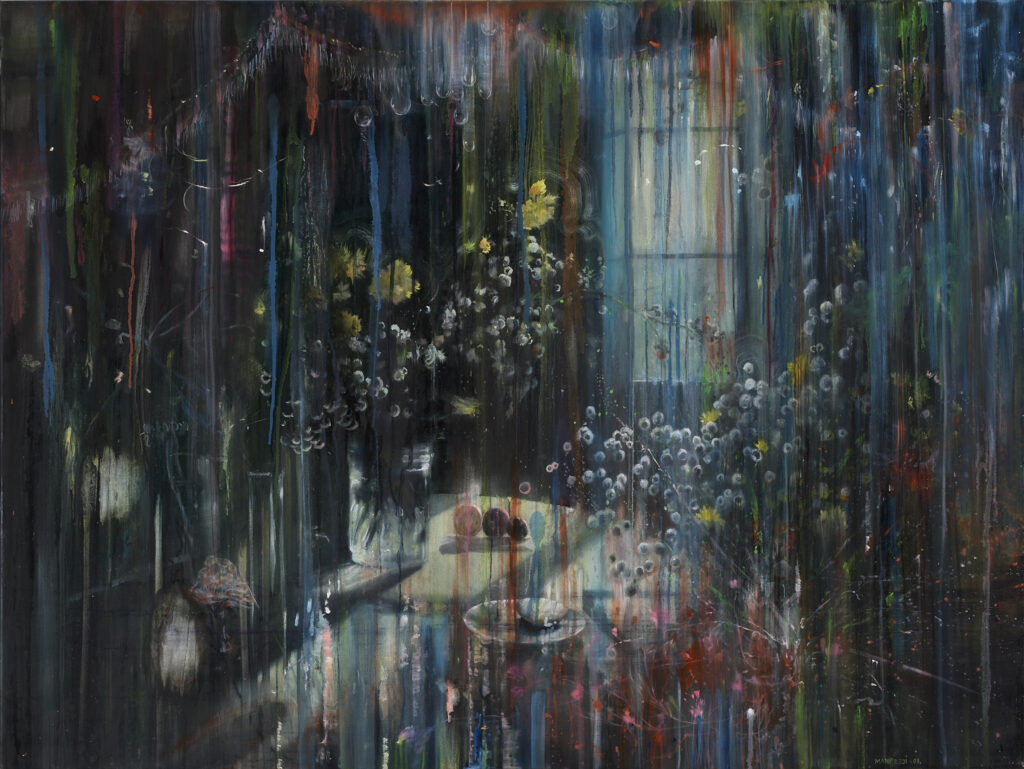
It is so difficult today to be a figurative artist and to be bold enough to pick up a paintbrush, stand before a canvas and try to paint something original, with more than 2000 years of art history, populated by unequalled masters and geniuses, behind us. Let us be clear: it is difficult, if one is conscious of the weight of the past. There are tens of thousands of painters who, without a second thought, paind portraits, landscapes and still life every single day. But if they are intelligent and sensitive they cannot fail to feel the weight and the responsibility to avoid falling into the obvious. The Italian artist, Manfredi Beninati, never falls into the obvious, even though he is essentially a figurative painter using such traditional techniques as oils.
My impression when I first saw this huge untitled painting was that I was faced with a huge negative photograph of an image in which the colours were reversed. I have no idea why, and perhaps … READ MORE
THE WHITE REVIEW
Lowenna Waters, Interview with Manfredi Beninati
LOWENNA WATERS — You have described the process of working on thirty to forty drawings at a time as ‘an organisation of the imagination’?
MANFREDI BENINATI — To me art is about sharing your personal experiences with the rest of the world.
Therefore the difference between a good (significant) artist and a bad (insignificant) one derives from the quantity of yourself you let into your work. Personal experiences translate into memories resulting from a period of time during which you have learnt something that allows you to discern them in a more sophisticated way than before. The same applies to a work of art. You need time to develop something not necessarily pleasing to others but strongly personal. Something that even just in a single detail shows a hidden spot of our reality through the imposition of your point of view, through trying not to let the other’s expectations influence your work. I think you need to spend time with your work and develop a narrative, and that’s why I’m constantly working on so many drawings, paintings, sculptures. I keep each one with me for months or even years. … READ MORE
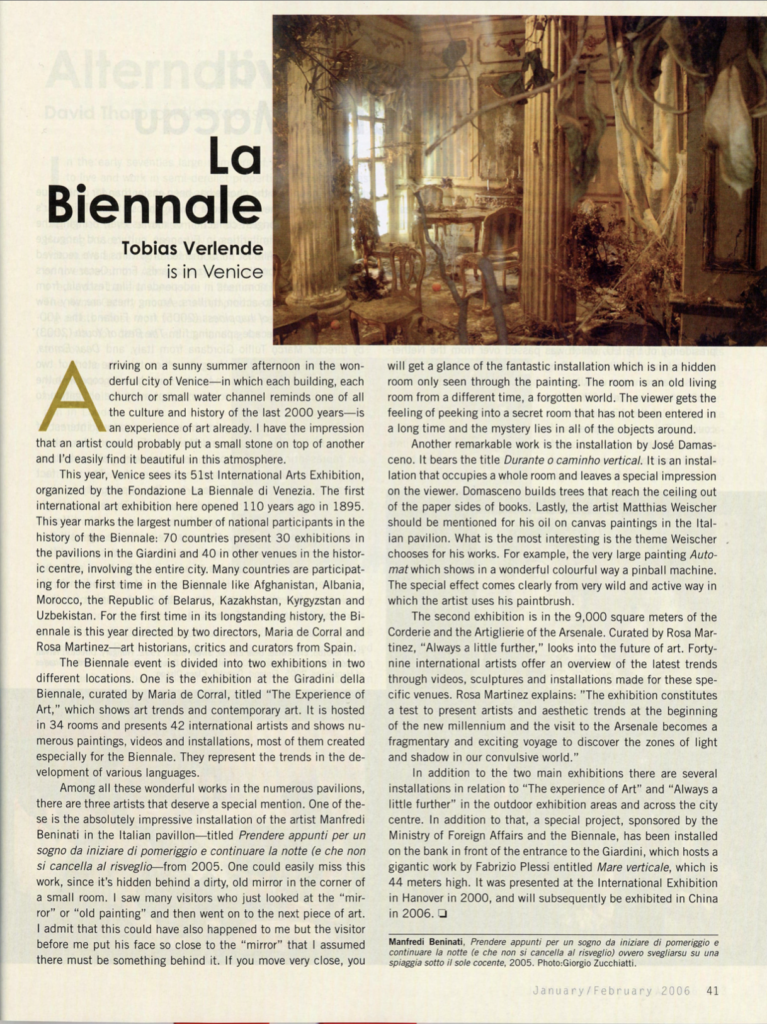
La Biennale
Tobias Verlende, NY Arts, Jan/Feb 2006
(…)Among all these wonderful works in the numerous pavilions, there are three artists that deserve a special mention. One of these is the absolutely impressive installation of the artist Manfredi Beninati in the Italian pavilion – titled Prendere appunti per un sogno da iniziare di pomeriggio e continuare la notte (e che non si cancella al risveglio) – from 2005.
One could easily miss this work, since it’s hidden behind a dirty, old mirror in the corner of a small room. I saw many visitors who just looked at the “mirror” or “old painting” and then went on to the next piece of art. I admit that this could have also happened to me but the visitor before me put his face so close to the “mirror” that I assumed there must be something behind it.
If you move very close, you will get a glance of the fantastic installation which is in a hidden room only seen through the painting.
The room is an old living room from a different time, a forgotten world. The viewer gets the feeling of peeking into a secret room that has not been entered in a long time and the mystery in all of the objects around. … READ MORE
MADE UP ON THE DAILY TELEGRAPH
THE 5TH LIVERPOOL BIENNIAL IS A GIDDY FINALE TO LIVERPOOL’S STINT AS EUROPEAN CAPITAL OF CULTURE, SAYS RICHARD DORMENT.
(Richard Dorment, “Liverpool Biennial: ‘Made Up’”, The Daily Telegraph, 22 September 2008)
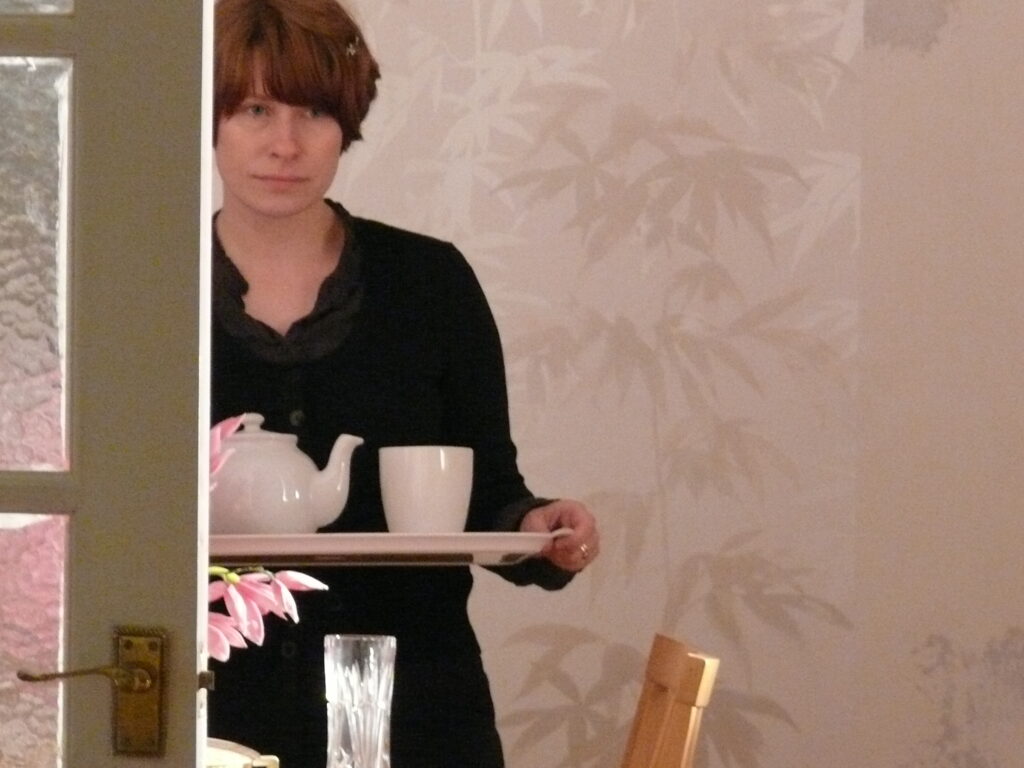
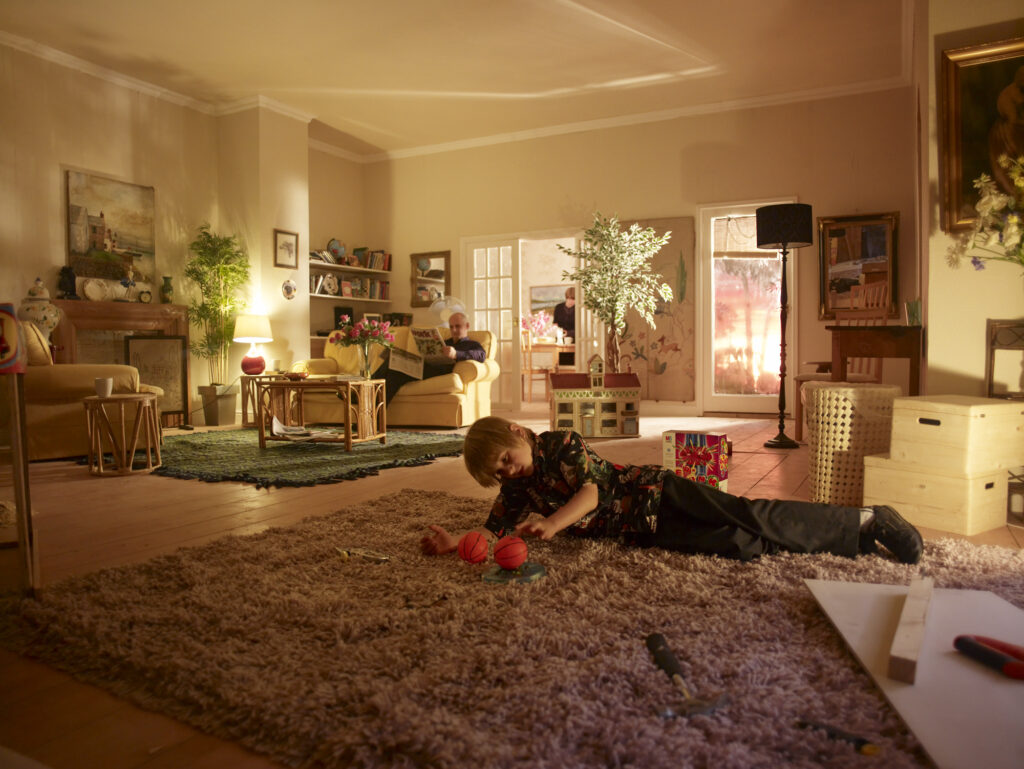
(…)To view the installation by Italian Manfredi Beninati you have to look through a window punched through the wall of a derelict building in the city centre. Standing there in the cold and dark, you are confronted with a vision of complete human happiness — a brightly lit drawing room with comfortable sofa and chairs, carpets, books, flowers, and a view through the window onto a tropical sunset. Newspapers and toys, a dolls’ house, and the tools dad is using to build a toy theatre lie scattered on the floor. But just as you are taking all this in, something moves and for the first time you notice the sinister figure looking in at the scene from the other the direction.
It takes a split second to realise that what you are seeing is your own reflection in the mirror hanging on the back wall. Beninati neatly demonstrates what it must be like to be on the outside looking in – to see comfort, warmth, love, and security but not to be a part of it. Wonderful. … READ MORE
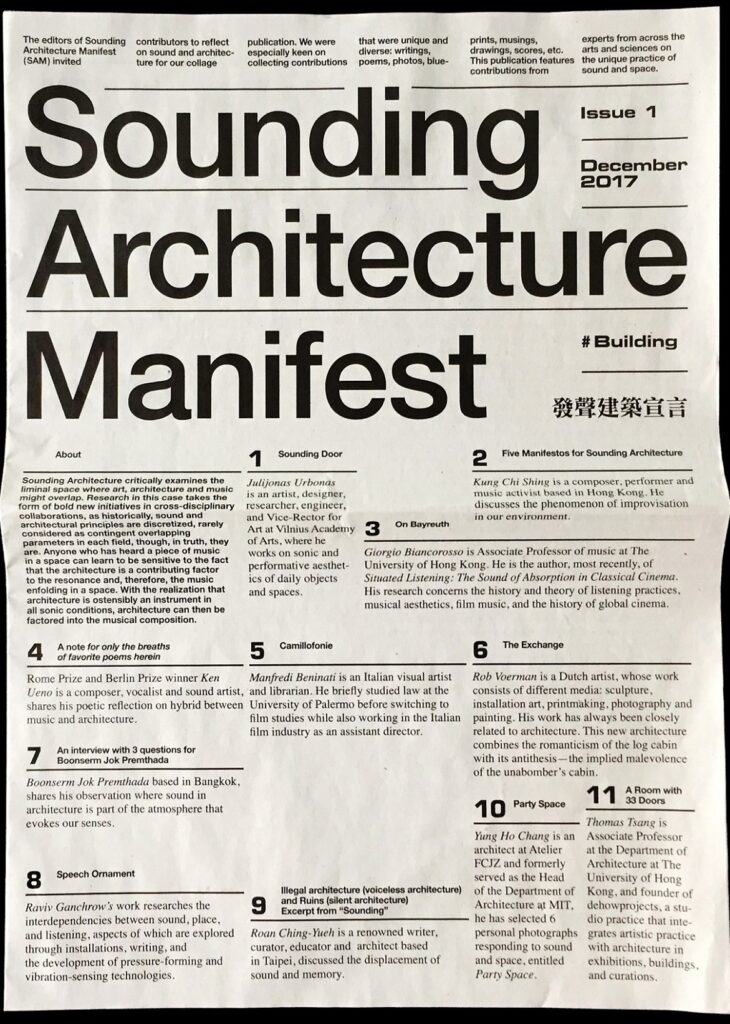

CAMILLOFONÌE WITH DEHOWPROJECTS IN SHENZEN
Sounding Architecture Manifest initiated by Thomas Tsang’s dehowprojects with and for arc-gestaltung.
Manfredi Beninati’s contribution to the Manifesto is an assay on Camillofonìe project, a series of recordings he made together with noiser and sound engineer Camillo Amalfi over a period of five years to explore the relationship between space and sound. … READ MORE
“TO THINK OF SOMETHING” PEERS INTO ANOTHER WORLD
CHRISTOPHER BROWN IN METRO LONDON.
This year’s Biennial is at its best when you stumble across things you were not expecting. During the day, you could easily walk past Manfredi Beninati’s piece without even realising it’s there.
A small panel indicates its existence but, surrounded by posters, it doesn’t stand out. The crowds of people that gather around to peer inside are the only giveaway. (…)
Looking in and behind the facade of the abandoned building, you’ll see the living room of, what looks like, an affluent family’s apartment. Toys and painting materials lie around the carpet as if they’ve been recently abandoned and a door is slightly ajar at the back, showing a dining room.
It feels as if you’re peering into a different world and, though this could effectively be nosing around somebody else’s home, the unoccupied room is so homely that it doesn’t feel voyeuristic or uncomfortable.
The fashions used help to reinforce the impression of peering into somebody’s childhood. It’s a pleasant and rewarding experience during the day, when you have to work hard to see everything through the sun’s glare… READ MORE
MORE WRITINGS


